Aa
  • Read, Watch, Listen
  • TJI Series
  • Community Action
  • Events
  • Zedi
Follow us and continue the conversation
  • LinkedIn
  • Instagram
  • FaceBook
  • X
  • YouTube
Test yourself with the TJI Quiz!

Adjust size of text

Aa

Follow us and continue the conversation

  • LinkedIn
  • Instagram
  • FaceBook
  • X
  • YouTube

Your saved articles

You haven't saved any articles

What are you looking for?

Original reporting, insightful analysis and diverse views, delivered straight to your inbox

  • LinkedIn
  • Instagram
  • FaceBook
  • X
  • YouTube
Your support fuels our mission to inform, entertain and inspire.

The Jewish Independent is bound by the Standards of Practice of the Australian Press Council. If you believe the Standards may have been breached, you may approach The Jewish Independent or make a complaint to the Australian Press Council in writing at www.presscouncil.org.au. The Council may also be contacted on 1800 025 712.

  • Our Story
  • Contact us
  • Our Team
  • Support us
  • Guidelines
  • Pitch your idea
  • Republishing us
  • Community Action
  • Our Awards
  • LinkedIn
  • Instagram
  • FaceBook
  • X
  • YouTube
Aboriginal FlagTorres Strait Islanders Flag

The Jewish Independent acknowledges Aboriginal and Torres Strait Islander peoples as the Traditional Owners and Custodians of Country throughout Australia. We pay our respects to Elders past and present, and strive to honour their rich history of storytelling in our work and mission.

© The Jewish Independent 2026All Rights Reserved
Website design and development by Your Creative, MelbourneTerms & ConditionsPrivacy Policy
HomeRead, Watch, ListenIsrael
FeatureIsrael

Abed has lost 28 members of his family in Gaza: ‘whoever wins this war, we all lose’

Michael Visontay
Print this

Published: 3 November 2023

Last updated: 5 March 2024

After the carnage of an Israeli air strike, Abed Rahman Sultan says trying to wipe out Hamas will backfire: other groups will rise up.

At 4pm on October 19, as Abed Rahman Sultan sat down to eat a late lunch with his family in Jordan, he received a WhatsApp message: an Israeli air strike made a direct hit on the building in Gaza where his extended family lived in various apartments. A total of 28 members, ranging from cousins and in-laws to children and elderly parents, were killed.

“The minute I saw the news, it was suffocating. I felt that I couldn’t breathe, that I couldn’t swallow the information. It was too much.

“This is not the first family that I know which has lost people. But usually, it happens to other people’s families. You don’t expect that direct family members would be hit,” he says.

Abed, 52, lives in Madaba, south of the capital Amman, where he works as Regional Program Director for EcoPeace Middle East, an environmental peacebuilding organisation that brings together Jordanians, Palestinians and Israelis to pursue climate solutions for the region.

He has not been to his family’s homes in Gaza and is not familiar with the strip and is unsure whether his family lived in the north or south. But that hasn’t affected the shock and grief he feels. “Sometimes the father dies, or the mother, and the family supports each other. But when the whole family collapses, you feel like you are left alone. There is the chance of the others being lost.”

There is no safe place we know in Gaza that people can go to right now.

Abed says his father is calling other members of his family in Gaza every day to check if they are alive. “They answer the phone or send a Whatsapp message to let him know. There is huge anxiety all the time; we don’t know what’s going to happen by the hour.

“There is no safe place we know in Gaza that people can go to right now. There is no guarantee that any place will be safe. I’ve seen a video with a UN aid convoy moving from north to south, and people followed it, thinking it was safe, and some of them were hit on the way,” Abed explains.
“That scared people. Even if there is a warning to leave, they don’t know where to go - so they stay at home.”

Abed is adamant that the only path forward is diplomacy and negotiation. “The major powers should apply more pressure to de-escalate, regardless of who started what. Retaliation for past violence is a vicious circle – that will never end.

It is nonsense to think you can kill everyone in Hamas. It is part of society. You don’t know who is Hamas and who isn’t.

“We need a summit where world leaders agree to stop the violence at any cost. Otherwise, if the war continues, whoever wins, we are all losing. It is a lose-lose situation.”

He says Hamas cannot be wiped out or eliminated. “It is nonsense to think that you can kill everyone in Hamas. It is part of society. You don’t know who is Hamas and who isn’t. In the same family you can have one brother who is Hamas, another brother who is PLO, another who is religious and another who is an atheist.

“You cannot control the mosaic, and you can’t tell who is linked to who.

“The root cause of the problem needs to be resolved. The root cause of the occupation needs to be ended. We need to work hard to ensure that respect is restored and peace is restored.”

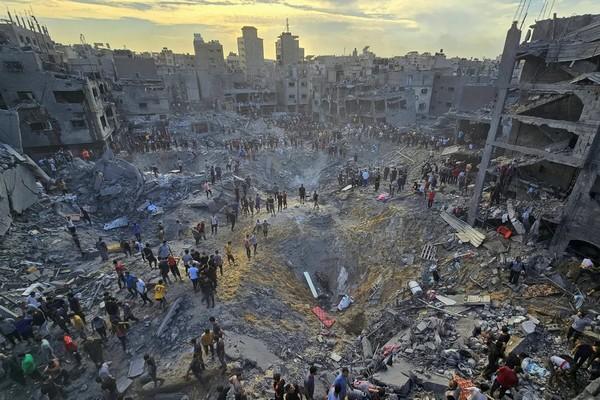
Palestinians search for casualties from a strike on the Jabaliya refugee camp, October 31 (Reuters)

Abed says several conflicting sentiments are running through Muslims in the region. The first is the religious sentiment. “People think that the Holy Land should be a peaceful area, that they should fight and die to make it peaceful.

There is also what he calls the “humanitarian sentiment”, which is brought out by the intensity and scale of death in Gaza. “We are not expecting to see that level of casualties; people are seeing so many dead bodies, it’s horrifying - that affects our emotional stability.”

The third sentiment is political. “Because the Israeli-Palestinian conflict has not been solved, people are angry. It’s creating a boiling point, a collapse in the system. I was scared when I saw the incident in Dagestan airport (where an angry mob stormed the runway looking for Jews landing on a flight from Israel). That’s the sort of chaos we don’t want to see. That’s where this region is heading.

I was scared when I saw the incident in Dagestan airport. That’s where this region is heading.

“I’m worried - about my kids, my family, my co-workers. I’m worried that no-one will be able to say something that can reduce the intensity of the chaos.”

Although Abed is clear-eyed about the gravity of what is happening, he still believes in the power of moderation – language, negotiation and diplomacy – to lower the temperature and open channels for genuine two-way communication.

“We need to have different rhetoric and discussions. At the moment it is all about hatred on both sides – eliminating Jews, or Palestinians. We need to invest more heavily in peace.”

By way of example, he points to the role Qatar is playing as an intermediary between Israel and Hamas. “Right now, the Qataris are playing an important role in negotiation for hostages. They could be an entry point [to de-escalation]. Let’s help them play a much larger role.”

“We can’t just have peace between lefties; we need to include the extremists. We can’t just eliminate each other or say to the other side, ‘we will wipe you out’. That is not a solution.”

If Israel tries to do that, he says, two things will happen. First, it will create a vacuum and second, it will radicalise a new group of Palestinians. “Other groups will rise up. They will be like Hamas or even worse.”

READ MORE
UN: Toll of Israel-Palestine crisis on children ‘beyond devastating’
(UN News)
Gaza has become a “graveyard” for children with thousands now killed under Israeli bombardment, while more than a million face dire shortages of essentials and a lifetime of trauma ahead, UN humanitarians said on Tuesday.

‘Children were carrying other injured children’: Witness describes aftermath of Israeli strike on Gaza refugee camp (CNN)
An Israeli strike targeting a Hamas commander in the Jabaliya refugee camp in northern Gaza has left catastrophic damage

Photo: Abed Rahman Sultan

You might also like
  • The Israelis who flew home to vote
    Gideon Cohen
  • Flooding and illness increase urgency of humanitarian relief in Gaza
    Shahar Burla
  • Australia’s latest sanctions raise the stakes, but stay on track
    Deborah Stone
logomark.67a07ee3
We believe in the free flow of information

Republish our articles for free, online or in print, by using our Creative Commons licence

You might also like

    Haredi United Torah Judaism
    Israel Votes 2026AnalysisIsrael

    Haredi party may change sides, enabling Eisenkot to form new government

    Shahar Burla
    Arab league
    Israel Votes 2026FeatureIsrael

    Dear Israel, we don’t care who your next prime minister is

    Michal Yaari 1
    ISRAEL-VOTE
    Israel Votes 2026AnalysisIsrael

    Growing pressure for a minority Change government in Israel

    Shahar Burla 1

About the author

Michael Visontay

More from the author

NewsAustralia

Matt Chun’s hate speech prompts change in arts funding policy

AnalysisAustralia

Mishandled antisemitism education is not just ineffective, it’s dangerous

FeatureLifestyle

Where Shtisel meets The Jetsons

ReviewIsrael

Beinart’s utopian vision ignores awkward truths